
Can You Trust Alibaba? A Buyer’s Guide to Safer Sourcing
Get up to 6% Cashback
Almost every first-time buyer asks the same question before ordering: what happens if the supplier vanishes once the deposit is paid? Here is the honest answer. Alibaba as a platform is trustworthy, yet individual sellers on it vary a lot. Buyers who treat these as two separate questions avoid most of the costly mistakes.
What Alibaba Really Is
Alibaba is not a seller. It is a meeting place where buyers find independent factories and trading companies, and it says that more than 200,000 suppliers are listed. The platform offers safeguards, but it doesn’t stand behind the quality of each product. Even the Verified Supplier badge only reflects what an inspector looked at, not a promise that the goods will be good.
So think of Alibaba as a business directory with a payment-protection layer attached, rather than an online store.
How It Differs From AliExpress
Jack Ma founded Alibaba in 1999, and it is now the biggest B2B sourcing platform in the world. The same group runs AliExpress, Taobao and Tmall, but the sites work very differently:
- AliExpress sells individual items to consumers at fixed prices.
- Alibaba.com sells wholesale quantities to businesses at prices you negotiate.
Three Things to Understand Before You Start
Minimum order quantities. These depend on the product. They can be as low as a few dozen units, with one typical listing asking for 50, while other products require several hundred.
Prices you negotiate. As this is a wholesale platform, a firm price comes only after you send an inquiry stating the quantity you want. Volume, payment terms and the relationship with the supplier all move the final number.
Factories versus traders. A manufacturer makes the goods itself and usually quotes lower prices, but with higher minimum orders. A trading company buys from factories and resells, which adds a margin and one more link in the communication chain. In return, some traders combine several product categories or manage exports for you. Neither is better by default: a responsive trader is worth more than a factory that never answers.
The Buying Process, Step by Step
- Search and compare. Listings tend to look alike, so look at response time, reviews, lead time and certifications, and contact several suppliers. Comparing quotes is the only way to see what a fair price looks like.
- Ask for a quote. Give the quantity, specifications and destination. The way a supplier replies is an early warning: slow or vague answers now usually mean slow or vague answers later.
- Order samples. Most suppliers will sell you a single sample, and getting more than one helps you judge consistency. If a supplier won’t provide samples, treat that as information. Aim for samples from at least three.
- Order and pay on the platform. After the deposit stage, you can pay the balance from the order details page.
- Handle shipping and customs. From this point you carry the responsibility. One published breakdown puts production at two to six weeks and sea freight at three to five weeks, so about five to eleven weeks overall, before customs clearance and local delivery.
Work out your landed cost, meaning the full price of getting the goods to your door, not only the price per unit. In one example, a $6 unit price rose to about $9 or more after inspection, freight, insurance, customs, duty and handling. In another, a $20 quote turned into roughly $29.18 per unit. Both come from US importers, so your own numbers will depend on your country and product.
What the Safeguards Cover
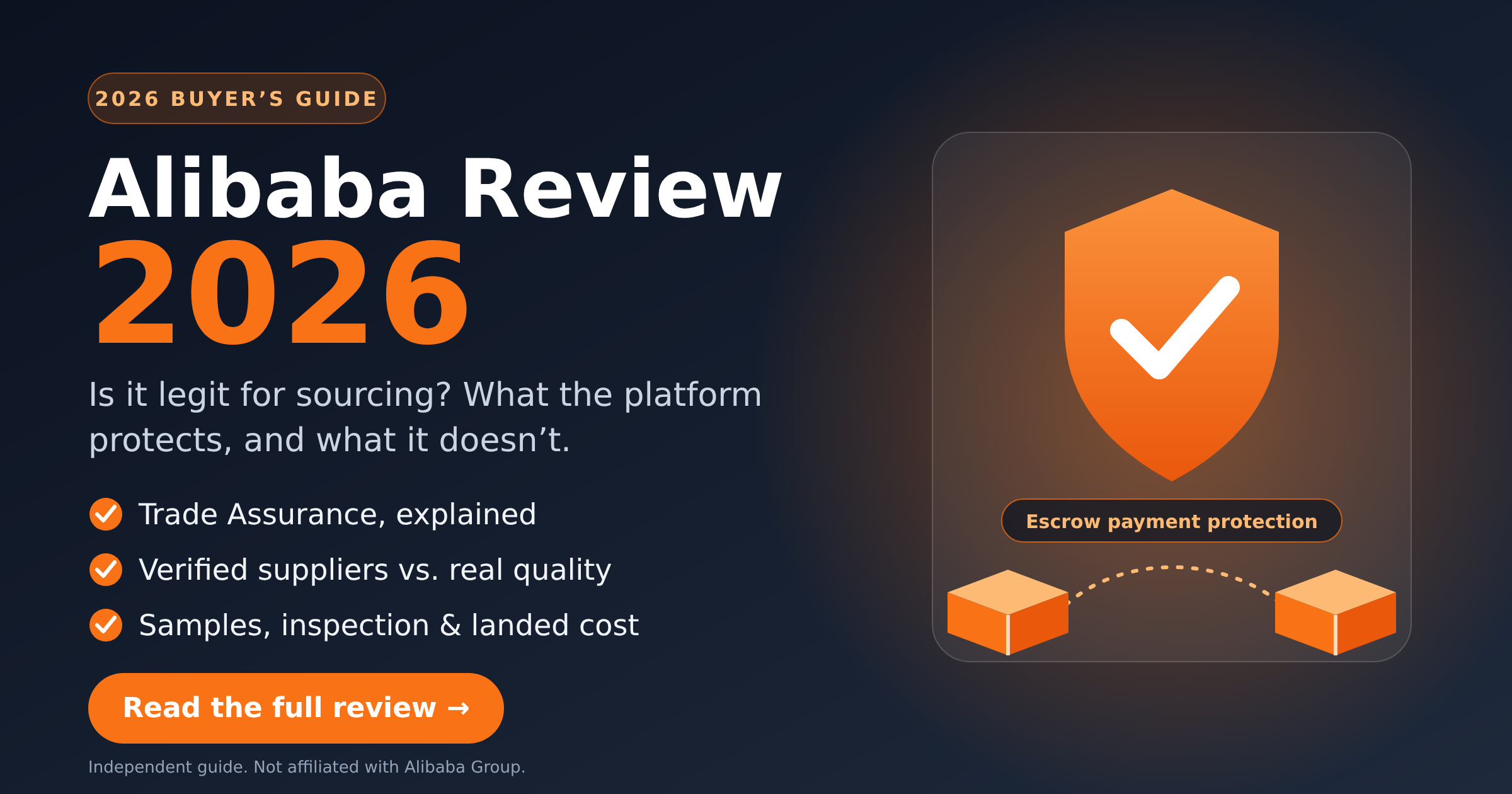
Trade Assurance is the main one. Your money sits in escrow and is released to the supplier only after you confirm that the order arrived. If the supplier misses the shipping deadline or the quality terms in your contract, Alibaba refunds the covered portion of your payment. Keep three things in mind:
- The protection travels with the payment. A verified supplier that you pay outside the platform leaves you with no protection at all.
- Your contract defines it. Trade Assurance does not replace clear order terms, and payment methods, settlement times and coverage vary with the type of order and the destination.
- Deadlines apply. If you don’t confirm the shipping documents within 15 days, the order is marked as complete automatically.
Verified Supplier is worth more than a logo but less than a quality guarantee. An independent third party examines the supplier’s business license, facilities, quality-control process and R&D capabilities. You can download the resulting report from the supplier’s company profile, so read it instead of trusting the badge.
Seller history and reviews reveal how a company actually behaves, through order volume, response rate and buyer feedback. Time on the platform matters too: accounts that are a year old or younger are more likely to be scams.
Main Risks and How to Handle Them
| Risk | What to do |
|---|---|
| Production quality below the sample | Book an independent inspection before the final payment |
| A trader pretending to be a factory | Ask directly whether they make the products themselves |
| Paying off the platform | Use Trade Assurance only |
| Language and time-zone friction | Keep everything in writing and test reply times |
| Late production | Agree on deadlines and penalties beforehand |
| Landed cost above expectations | Include freight, duties, handling and delivery in your budget |
| Customs trouble | Document and classify the shipment properly |
| Intellectual property issues | Refuse products that copy protected designs |
The sample-versus-production gap is the most damaging one. Some suppliers make their samples by hand with better materials than the ones used in mass production, and you only discover it after the balance is paid. An independent inspection costs far less than a bad shipment: agencies like SGS, Intertek and Bureau Veritas typically charge USD 250 to 400 for a detailed photo report.
The most expensive error of all is letting a supplier move the payment elsewhere. Changing the payee at the last minute is among the most frequent and costly scams.
Choosing a Supplier You Can Rely On
- Draw up a wide shortlist of five to ten suppliers, so you can see the real price range.
- Judge behavior over badges: transaction history, order volume and response rate.
- Ask whether they manufacture or resell. Evasive answers usually mean they trade.
- Send a detailed inquiry covering materials, tolerances, packaging and lead time, then assess the quality of the reply. It costs nothing and filters out many weak candidates.
- Buy samples from at least three companies and compare them side by side.
- Check independently: ask for a video tour of the factory, verify the business license or hire an inspection service.
- Write everything down: specifications, tolerances, packaging and delay penalties.
- Begin with a small order. It teaches you how the supplier communicates, how good the product is, whether they deliver on time and what the true landed cost is. Paying a few percent more per unit on a trial run is cheaper than discovering a defect across a thousand units.
Conclusion
Alibaba can be trusted as a platform, but not every seller on it deserves the same trust. Trade Assurance is the safeguard that counts. The Verified badge shows a company was inspected, not that its products are good. And a supplier’s real behavior says more about them than any badge. The single most costly choice you can make is paying outside the protection system.